Food Hunt Level 713 Walkthrough
To clear Food Hunt level 713, begin with white, remove the yellow and orange leaves, and work through the blue and grey layers before the enclosed final shades. The picture shows a grey-and-white hooded figure holding a scythe and a green plant among autumn leaves. Work through its 10 colors with the heavily enclosed shades kept back; dark sky blue and pale orange should wait until the surrounding picture opens.

Most of this board is covered in layers, including half of the large white area. Grey has most of its pixels hidden, dark grey has almost all hidden, and light grey and pale blue also need extensive neighboring clearance. Several such boxes placed together can stop making progress at the same time. Above the figure hangs a spider on a web, and wooden plaques marked 50 lie over the picture without forming part of this solution.
| Picture | Hooded figure with a scythe and green plant, yellow autumn leaves and a spider above |
|---|---|
| Colors | 10 |
| Largest area | White, one sixth of the board |
| Visible plaques | 50 |
Color Order Through the Hood and Autumn Leaves
White; yellow leaves and orange; light blue; grey, light grey and pale blue as their paths open; dark grey late; dark sky blue and pale orange at the finish.
Read the early white choice as the start of a continuing job rather than a demand to finish white before selecting anything else. The yellow and orange leaf areas uncover part of the hood while white remains active. Later, choose between the blue and grey shades according to access and the boxes that have reached the bottom queue. The final dark sky blue and pale orange are different from these partially covered middle colors: neither can do its real work until the surrounding layers are removed. Keep that distinction in mind when the picture still looks crowded.
Solution for Uncovering the Hooded Figure
- Start the white layer. Take white as soon as it becomes an available choice. It fills one sixth of the board, the largest share of any color in this level, and needs the longest start. The ants can eat its exposed half immediately, while the covered half waits behind neighboring colors. Expect the white box to remain active through later choices instead of trying to force its counter straight to zero.
Video walkthrough of level 713
Follow the video from the white opening through the yellow and orange leaves into the grey layers of the hood. The late dark sky blue and pale orange work shows why those boxes need their surroundings cleared first.
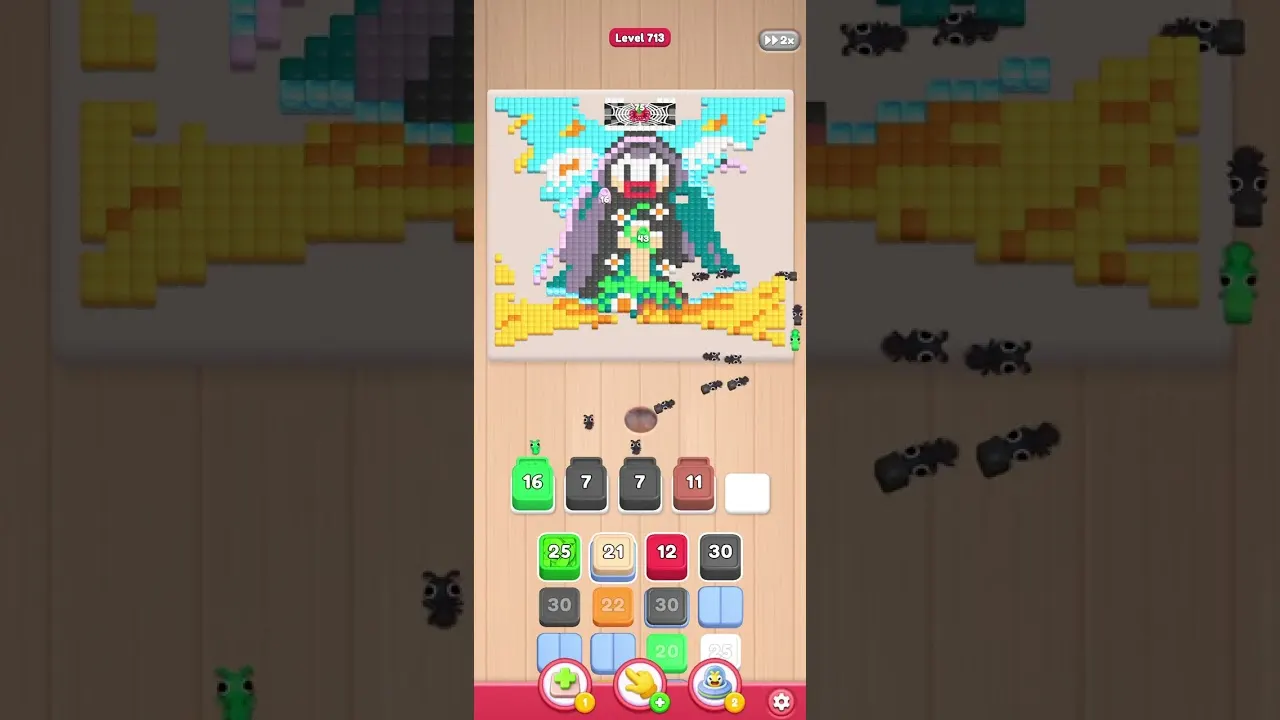
- Remove the autumn leaves. Move to the large yellow leaf area around the figure. These pixels are mostly accessible, allowing the yellow ants to remove them quickly and uncover more of the drawing. Orange follows in the leaf section and clears more of the autumn-colored covering. As that outer work disappears, additional white hood pixels become reachable and the opening box can resume chewing those newly exposed patches.
- Separate the light blue shades. Bring in light blue after yellow and orange have made some progress. Pale light blue remains much more heavily covered, so leave that shade waiting until its approach is clear. The choices in the lower queue change as earlier boxes finish, and you should follow what it offers at this stage. Avoid pairing an inaccessible pale blue box with the waiting white one just because the two colors are already visible in the picture.
- Release the grey parts individually. Grey and light grey need a substantial amount of white and blue clearance before their hidden pixels can be eaten. Choose these shades separately so their waiting periods do not occupy several slots together. Dark grey is even more enclosed and belongs near the end of the grey work. Hold back the three grey shades while space allows, then introduce each when neighboring removal gives its ants a useful route.
- Leave the fully enclosed pair alone. Dark light blue is surrounded by white, light blue and six additional colors. Pale orange is also fully enclosed, leaving its box without accessible work if you load it too soon. Both can sit for a long stretch, which is an expected result of the covered picture. Let the white, blue and grey neighbors clear first rather than committing two places to boxes whose paths are still sealed.
- Finish the newly exposed colors. Once white and the grey and blue layers have reached zero, the final pair can be reached by its ants. Place dark sky blue and pale orange at this late stage and allow them to clear the remaining picture. If either box was already selected, its access opens through the same neighboring clearance. Wait for the last reachable pixels to disappear; an earlier idle counter does not require a different finishing method.
Why White Pauses Before the Final Blue Pair
The white pause comes first. Only half its pixels are initially exposed, and the remaining half cannot be eaten until the neighboring layers are removed; the box leaves around the middle of the clear. Later, dark sky blue and pale orange can occupy two slots without moving if you select both too early. Their complete enclosure is a stronger restriction than the partial cover on white, so they belong at the other end of the sequence.
Protect one or two slots for colors with immediate access while managing the grey section. Grey, dark grey, light grey and pale blue are poor choices for a whole group of simultaneous waiting boxes. Add a heavily covered shade individually after its neighbors have thinned out. Yellow and orange leaf clearance gives you useful early work, while the plant in the hands stays hidden until later layers are removed.
Frequently Asked Questions
How do you beat Food Hunt level 713?
Start white, which occupies 1 sixth of the board, and use yellow and orange to remove the leaves around the figure. Continue through light blue and the greys without loading them all together. Reserve dark sky blue and pale orange for the open final layers.
What is the first color for level 713?
White should begin this 10-color clear because its area is larger than any other shade. Its exposed half can be eaten while yellow leaves and orange open the covered half.
Why is the dark sky blue box not decreasing?
White, light blue and 6 further colors surround every dark sky blue pixel. Until those areas clear, that box has no reachable work. Pale orange has the same complete enclosure, so both belong late.
How can I avoid a blocked queue around the grey shades?
Introduce dark grey or pale blue individually after their neighboring colors have opened. Save 1 or 2 slots for quicker exposed work rather than collecting several nearly enclosed greys together. This keeps the queue usable while white finishes its hidden half.
What color sequence should I follow on level 713?
White comes before yellow and orange, with light blue and the grey shades handled as the lower queue advances. The 2 fully enclosed finishing shades are dark sky blue and pale orange. Choose them after the white, blue and grey layers have been eaten.
Read next


Stuck somewhere else? Pick another number on the Food Hunt levels page, or start with the Food Hunt walkthrough basics if the slots and boxes still feel new.