
Food Hunt Level 1045 Walkthrough
For Food Hunt level 1045, send dark cyan first, use cyan and purple immediately afterward, and delay the enclosed red until the ending. The pixel scene shows a blonde girl wearing a purple jacket in a stable, with a brown horse looking through the upper window and a spider on its web. There are 10 colors; dark cyan covers the largest area, while cyan and purple have accessible pixels from the start. Work through the covered layers before finishing on the last red pixel.
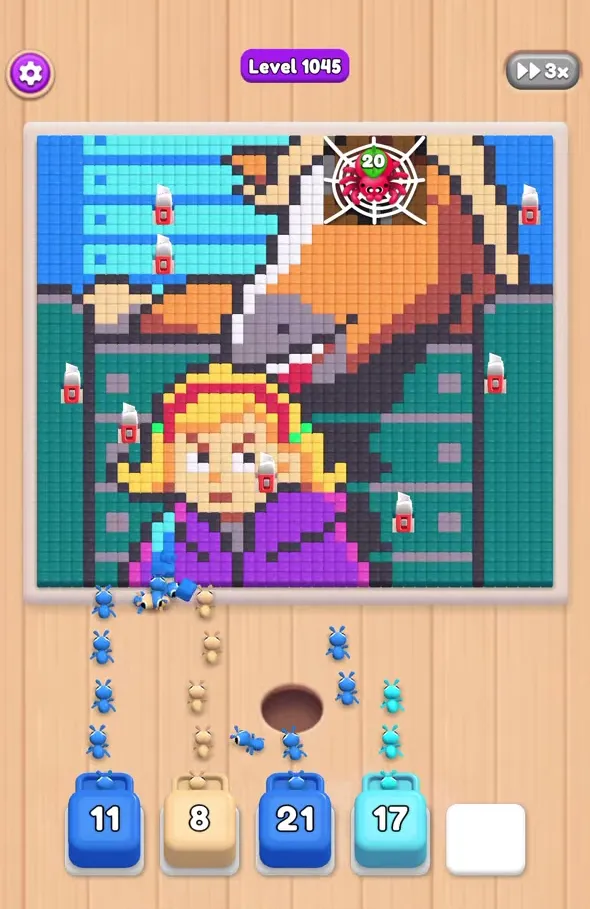
The challenge is keeping useful slots available while most colors wait for access. Orange is almost wholly surrounded, white and pale red are nearly as enclosed, and most grey pixels are blocked too. Even the large dark cyan opening box has some covered pixels, so it remains in a slot for a long stretch. A lineup full of waiting colors leaves no place for the next box that could expose those pixels.
| Picture | Blonde girl in a purple jacket, stable window with a brown horse, spider on a web |
|---|---|
| Colors | 10 |
| Largest area | Dark cyan |
| Accessible at the start | Cyan and purple |
| Slots to manage | 5; no more than 2 waiting boxes together |
| Final pixel | Red |
Stable Answer Key: Accessible Colors Before Red
Dark cyan, then cyan and purple, followed by dark grey and grey; pale orange after deeper clearing; white and pale red late; fully surrounded red at the finish. Delay the heavily enclosed orange until dark cyan and grey have progressed.
Use the queue to apply this order: you can only choose the boxes it actually offers. Dark cyan needs the early start because of its size, while cyan and purple give the other slots active work. Grey and pale orange become practical after their neighbors have been eaten. The late white and pale red stages require separate introductions so that both do not become another waiting pair. Orange also needs a thinned board, and red has no reachable pixels until its surrounding colors have cleared enough space.
Stable Scene Solution Through Six Layers
- Start the largest area. Take dark cyan as soon as it becomes available in the queue. More of the stable picture uses this color than any other, so its counter needs the longest run of chewing. Some dark cyan pixels are surrounded, meaning the opening box cannot complete everything immediately. Starting early lets it remove the accessible area while the next useful colors begin working beside it.
Video walkthrough of level 1045
The stable-scene video follows dark cyan into the accessible cyan and purple passes before the enclosed late colors. Watch the thinning picture to relate those waits to the final red pixel.

- Clear with cyan and purple. Both cyan and purple are open from the beginning of level 1045. Play them when offered so their ants can remove exposed pixels while the enclosed colors still wait. These two colors clear quickly instead of taking up slots for a long period. Their progress also opens routes into the covered parts of the stable, giving the slower middle colors a useful next stage.
- Move into dark grey and grey. Dark grey advances after the upper color layers have cleared. Introduce grey once cyan has already removed a substantial part of its accessible area, because most grey pixels remain surrounded earlier. Grey may still stop while its neighbors are being eaten. Preserve at least one available slot alongside that wait so that a useful queue box can join the active colors.
- Wait for pale orange access. More than half of pale orange is covered by other colors. An early pale orange pick therefore commits space before much of its work can begin. Let dark cyan and grey reach farther into the picture before introducing it. With those surrounding areas reduced, the pale orange ants can reach more pixels and its counter starts making sustained progress.
- Separate the late pale colors. White has almost all its pixels enclosed, with pale red in a similar position. These colors belong in the last third of the clear, after the stable scene has become much thinner. Add one and then assess the next offered choices before adding the other. That separation avoids using two slots on equally inaccessible jobs while a less enclosed box could still help.
- Finish the red remainder. Dark cyan, dark grey and six more colors surround every red pixel. Red therefore has the strongest dependency on earlier work, and its box can spend a long stretch simply waiting. Bring it in when most of the picture has already disappeared. The final red pixel ends level 1045, so the long wait has a specific place in the route rather than calling for a different opening color.
Why Red Waits Behind the Stable Layers
Look at the red enclosure first. Eight colors surround it, including dark cyan and dark grey, so red cannot advance just because its box has entered a slot. Orange has nearly its whole area covered as well, and white and pale red face much the same problem. A stationary counter on one of these colors tells you to continue the surrounding layers rather than immediately committing another similar box.
Then check which waiting boxes you have combined. Keep the total at two or fewer, and remember that dark cyan already occupies space for a long time. Avoid pairing both grey and pale orange alongside that long opening job. Cyan and purple offer quick clears that release space, but the bottom queue decides whether they are available; wait for a suitable choice when the offered set cannot improve access.
Frequently Asked Questions
How do you beat Food Hunt level 1045?
Start dark cyan, then take accessible cyan and purple to open the stable layers. Work through the 10-color scene with no more than 2 stalled boxes together, leaving enclosed red for the final pixel.
Which color opens the stable level?
Dark cyan should lead because it covers the biggest area among the 10 colors. Follow it with cyan and purple, the two colors whose pixels are free from the opening.
Why does the red box stay in its slot?
All red pixels sit behind 8 surrounding colors, including dark cyan and dark grey. The ants need those neighbors removed before they can finish red, so its long pause belongs to the intended late clear.
Should I play orange immediately?
Delay orange until dark cyan and grey have eaten deeply enough into their sections. Almost its whole area is enclosed, making it one of the waiting colors in this 10-color board rather than a productive opening pick.
How do I keep the five slots from clogging?
Allow at most 2 waiting boxes together, and avoid the red-and-white pairing. Use cyan and purple for quick progress in the 5-slot lineup, choosing from the queue instead of tapping an arbitrary covered color.
Why does level 1045 have so many pauses?
The stable contains 10 colors with heavy enclosure: orange is almost completely covered, and grey and white have most of their pixels behind other sections. Cyan and purple provide the accessible opening work, while the video follows the full route through the longer waits.
Read next



Stuck somewhere else? Pick another number on the Food Hunt levels page, or start with the Food Hunt walkthrough basics if the slots and boxes still feel new.