Food Hunt Level 613 Walkthrough
For Food Hunt level 613, launch light blue, follow with blue, then use dark grey, grey, red and white as the queue offers useful access. A yellow chick sits beside a campfire against a light blue brick wall dotted with spiders on webs. This campfire picture uses 11 colors. Orange and the pale shades should wait until the surrounding colors open routes into their pixels.
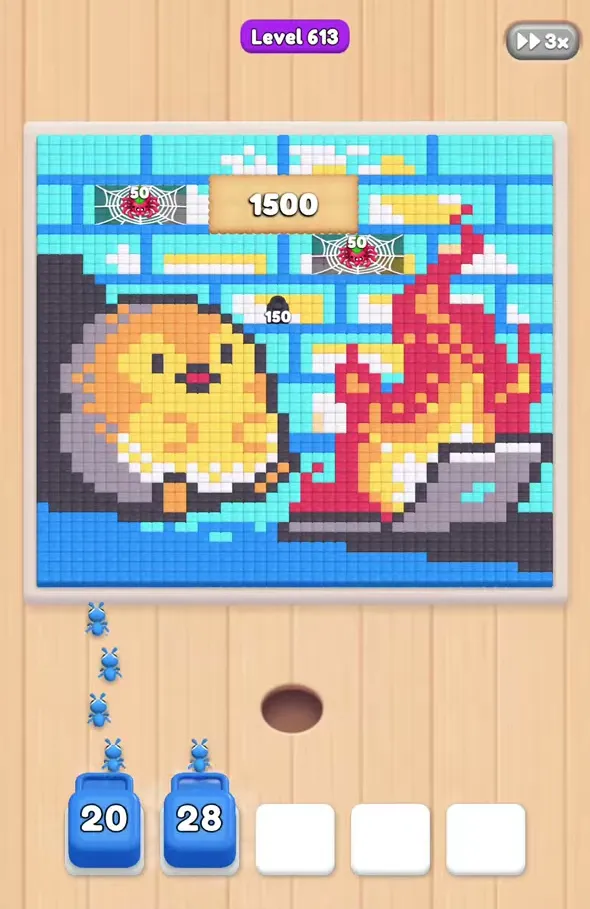
Most colors have substantial areas surrounded by their neighbors. Orange is the clearest example: every orange pixel is fenced in by dark grey, yellow and four additional colors. Yellow and two of the pale shades also have very little open space. With 5 slots, committing these restricted colors together leaves too little room for the larger accessible work that needs to uncover them.
| Picture | Yellow chick beside a campfire in front of a light blue brick wall with spiders on webs |
|---|---|
| Colors | 11 |
| Color names | Light blue, blue, dark grey, grey, red, white, yellow, orange, pale orange, pale blue, pale light blue |
| Slots | 5 |
Chick and Campfire Answer Key
Light blue, blue, dark grey, grey, red and white; introduce yellow as access allows, then orange, pale orange, pale blue and pale light blue.
Use the color progression to judge which areas can become reachable next. Read light blue and blue as the large opening, the four medium colors as the route into the chick and fire, and orange with the pale shades as access-dependent cleanup. Yellow can wait in a slot for much of its surrounding area to disappear, so do not force that pick ahead of a useful open color. Use the bottom queue to choose the next available box within this plan.
Brick Wall Walkthrough to the Pale Shades
- Start eating the light blue wall. Choose light blue immediately when the queue makes it available. It is the largest color by pixel count on this level, so its ants have the most work to finish. A substantial part of that area is open at the beginning, allowing the counter to fall as the ants eat. Starting early gives the large wall color time to work while you deal with other parts of the scene.
Video walkthrough of level 613
This chick walkthrough shows the light blue wall and blue opening, the middle colors exposing yellow and orange, and the pale shades clearing after their neighbors.

- Add blue with room around the pair. Blue is the second-largest color after light blue. Put it into a free slot after the light blue box so both large areas can move toward zero. These opening boxes occupy two places, leaving the other three for flexible choices. Avoid spending those remaining spaces on fully enclosed colors before the larger opening has created any useful access.
- Work through the medium shades. After the blue opening, take dark grey and grey when they can work. Dark grey forms part of the enclosure around orange, so clearing it helps a later color as well as its own counter. Red comes next with some exposed pixels despite most of its area being surrounded. White also has reachable sections, making it a useful follow-up instead of jumping straight to the completely fenced-in orange.
- Allow yellow to become reachable. Yellow has almost all of its pixels surrounded, so its box may need a patient wait. Its ants initially reach only a small portion while the neighboring colors remain in place. Delay yellow if a more open color needs the available slot. Once light blue and blue finish, the released spaces give you more room to manage yellow without crowding the earlier clearing work.
- Open the route into orange. Dark grey and yellow need to be noticeably eaten back before orange becomes a sensible pick. Every orange pixel starts behind these colors and four other colors from the picture. A motionless orange counter is therefore an expected consequence of its enclosure. Continue with working colors around it and allow the borders to disappear before expecting that box to empty.
- Clear the pale finishing shades. Pale orange, pale blue and pale light blue all have enclosed areas, with the first and last almost entirely blocked. Bring them in once the neighboring colors have gone. The bottom queue controls the offered picks as earlier boxes clear, so their final selection order follows that availability. Preserve one or two slots for these ending colors rather than making the last stage wait behind unrelated idle boxes.
Why Orange Waits Behind the Chick
Orange is waiting for a specific enclosure to disappear, rather than for another tap on the fire. Dark grey, yellow and 4 further colors surround every orange pixel. Until those borders open, the orange ants have no matching target they can reach. This is why clearing dark grey in the middle matters, and why sending orange into a slot before yellow has made progress can create a long, unproductive hold.
Yellow, pale light blue and pale orange have nearly all their pixels blocked as well. Red and pale blue also have most of their areas surrounded, but pale blue has relatively more open pixels than the other two pale shades. Keep at least 1 of the 5 slots empty until the middle, and avoid an enclosed orange box alongside another heavily blocked shade. When a working box reaches zero, use that released space for the next color whose neighbors have actually cleared.
Frequently Asked Questions
How do you beat Food Hunt level 613?
Open with light blue and blue, then clear dark grey, grey, red and white as offered. Use the 5 slots carefully while yellow opens, and leave orange and the pale shades until surrounding colors are eaten. Retain 1-2 places for the finishing group.
Which color should start the chick board?
Light blue is the largest of the 11 colors, so choose it first when available. Blue is the next-largest and follows it. Those opening boxes use 2 slots while their ants clear the broad accessible areas.
Why does the orange box stay at the same number?
Dark grey, yellow and 4 other colors enclose every orange pixel on level 613. Its ants cannot reach those targets until the surrounding sections are eaten. Wait for that access rather than adding another heavily enclosed box to the 5-slot row.
What if every slot is occupied on level 613?
Yellow, pale light blue and pale orange can all be waiting on almost completely enclosed areas. Let a working box reach zero before selecting another restricted color, and plan to retain at least 1 free slot during the first half. Avoid committing orange and pale light blue together before their borders open.
Read next


Stuck somewhere else? Pick another number on the Food Hunt levels page, or start with the Food Hunt walkthrough basics if the slots and boxes still feel new.